
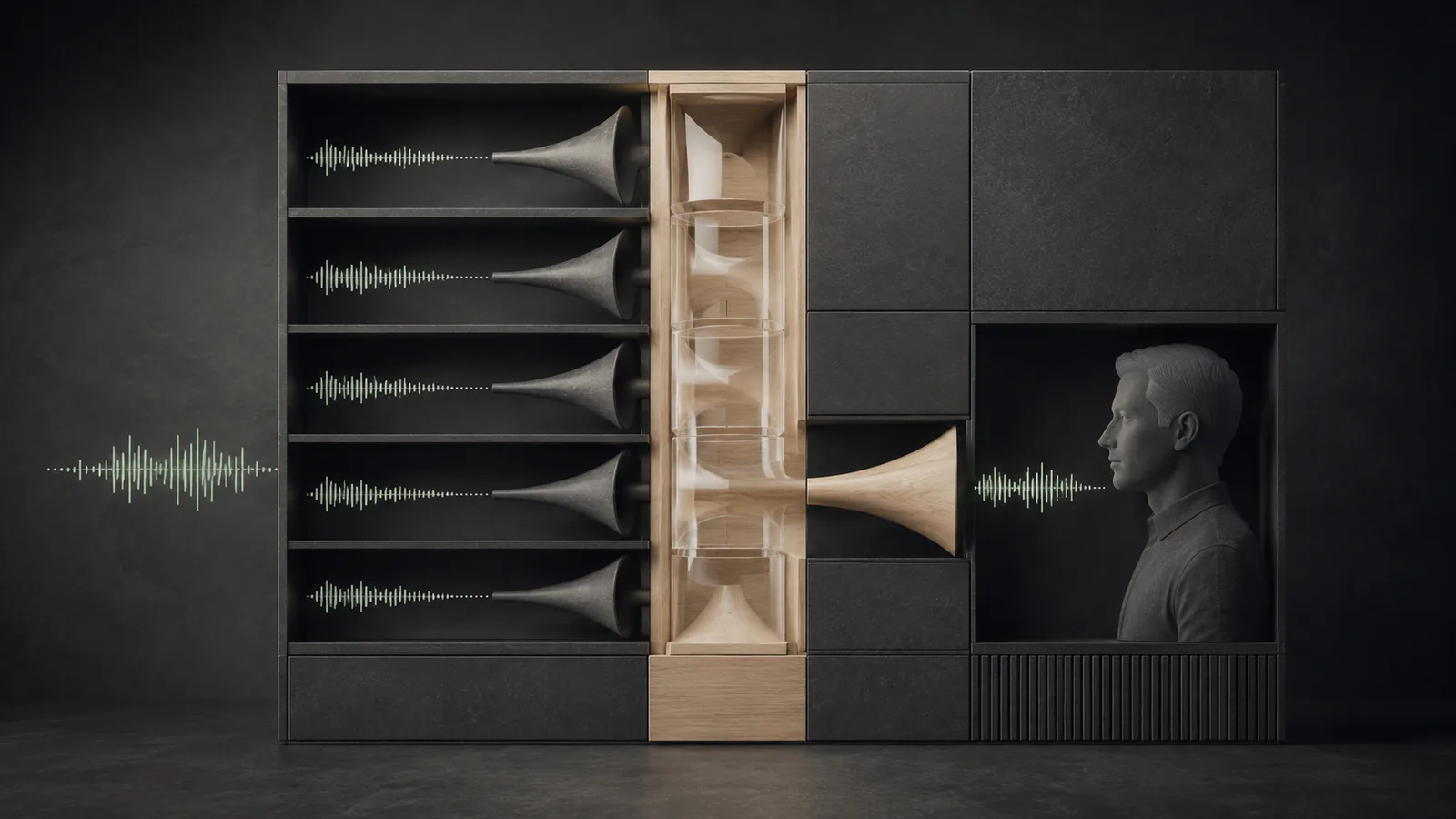
OpenAI introduced GPT-Live on 8 July. The important promise is not simply a nicer voice. Its full-duplex architecture can listen and speak without waiting for the classic end of every turn. Interruptions, short acknowledgements and pauses can therefore feel more natural.
That matters to Swiss service businesses, but not for the reason a product demo highlights first. A friendly “mm-hmm” does not recover a job if the phone number was captured incorrectly. Voice AI improves when conversational flow and process quality improve together. That is where measurement should start.
Full duplex addresses a real phone problem
Many older voice systems operate in rigid rounds. The customer speaks, waits, hears an answer and starts again. A short thinking pause may be treated as the end; an interruption arrives too late or is ignored. This feels artificial and forces people to repeat information.
A system that listens while speaking can make better decisions about when to acknowledge and when to remain quiet. For names, registration numbers, addresses and appointment requests, a smoother exchange can genuinely reduce effort.
Natural sound is not operational competence
The demo effect is dangerous because people associate a pleasant voice with competence. An assistant can react naturally and still select the wrong branch, store an incomplete callback note or escalate a special case too late.
Evaluation must go beyond latency and voice quality. The central question is whether everyone knows what happens next when the call ends. Our guide to what an AI phone assistant really does separates capability from boundaries.
An interruption can change the meaning of the call
Customers interrupt for more than impatience. They correct an assumption, add a condition or stop the conversation moving in the wrong direction. A useful system must not only stop speaking. It must recognise which part of the earlier state is now invalid.
If a caller says “No, not next Tuesday, I need this week,” the old preference cannot remain active in the background. That correction belongs in the test set. Smooth speech without reliable state management is simply a more attractive source of errors.
Four measures that tell you more than response time
Latency still matters because long gaps damage confidence. It is only one dimension. A service company mainly needs to know whether the request was captured completely, classified correctly and closed with a useful next step.
Metrics should reflect real call types. An appointment, price question, complaint and urgent case need different success criteria. If all calls disappear into average duration, the important failures stay hidden.
- share of requests captured completely
- corrections handled after interruption
- handovers containing usable context
- follow-up questions required by staff
- drop-offs occurring at the same dialogue point
A good handover starts before failure
Many systems ask for a person only after they are stuck. Better systems have visible escalation rules. Complaints, sensitive data, unclear pricing or repeated corrections can signal early that automation should not finish the case.
The employee needs more than “customer requests callback.” They need name, reason, urgency, confirmed details and the open question. This prevents the customer repeating the entire story. Our human handover map for AI agents explains that design.
Multilingual calls remain a separate test
A model can support many languages and still sound wrong locally. Swiss German, French pronunciation of place names and mixed Italian usage in Ticino create different demands from an international demo.
Do not use translated scripts alone. Test real expressions, names, municipalities and industry terms from the business. Our article on Swiss German and voice AI explains why an honest language boundary is stronger than an inflated promise.
What to test before changing models
You do not need to switch every line at once. Our guide to voice AI reception shows how to test a tightly defined front-desk use case first.
Do not route every live call to a new voice model on a Friday evening. Build a small test set from anonymised or safely recreated cases. Include normal conversations, fast speakers, background noise, interruptions and deliberately ambiguous requests.
Compare more than old versus new speech. Confirm that tools, calendars, CRM fields and escalation paths still work. Better conversation can be cancelled immediately by a broken integration.
- ten frequent standard requests
- five difficult interruptions or corrections
- multilingual names and locations
- two sensitive cases requiring immediate handover
- one simulated calendar or CRM outage
The best pilot is small enough to hear
Start with one call type or a limited time window. With appropriate consent and privacy controls, review the first conversations for more than technical errors. Listen for language that feels pushy, too casual or unnecessarily long.
Include the people who call customers back. They notice immediately when notes are incomplete or expectations are wrong. Voice AI then improves where work continues, not only in a laboratory.
What management should hear before launch
Do not play only the best demonstration. Review one successful standard call, one difficult correction and one clean human handover. Those three recordings reveal more about operational readiness than a slide deck.
The useful question is not “Does it sound human?” Ask whether the team could continue the work calmly the next morning with the information produced. That separates an impressive voice from a dependable service process.
Conclusion: the best conversation ends in clarity
GPT-Live raises expectations for digital conversation. Less rigid turn-taking and better interruption handling are meaningful progress. For a business, they are only half the work.
Good voice AI does more than sound pleasant. It recognises corrections, knows its limits, documents the request and hands over without losing context. Then natural speech becomes an advantage. Otherwise it only makes a weak process more convincing.
FAQ
What is new about GPT-Live?
Its full-duplex architecture can listen and speak more continuously, enabling more natural pauses, acknowledgements and interruptions.
Should a company switch its voice system immediately?
No. Test real call types, integrations, handovers and language variants first, then roll out gradually.
Which voice AI metric matters most?
No single metric is enough. Complete capture, correct corrections, useful handovers and fewer staff questions work together.
Does GPT-Live handle every Swiss language perfectly?
No. OpenAI notes possible accent and fluency gaps. Swiss German and regional terminology require dedicated testing.
Find the first lever worth fixing
A short business check shows whether phone, website, chatbot or an internal workflow deserves attention first.
Start the free business check